Automotive Information

Let's help each other. Cars stuff, computers,girls, etc.
User avatar
Chai
RaceJunkies B*tch
Posts: 3070
Joined: Mon Jun 13, 2005 3:31 pm
Location: Aruba
Contact:

Automotive Information

Post by Chai »

[SIZE="3"]Esaki ta specialmente pa e newbie members y hasta existing member pa nan amplia nan knowledge. Otro members, please post mas info cu pics si por[/size] :thumbsup: :scholar:

Si bo tin un request , post e numa y mi lo waak pa mi hanja informacion pa post

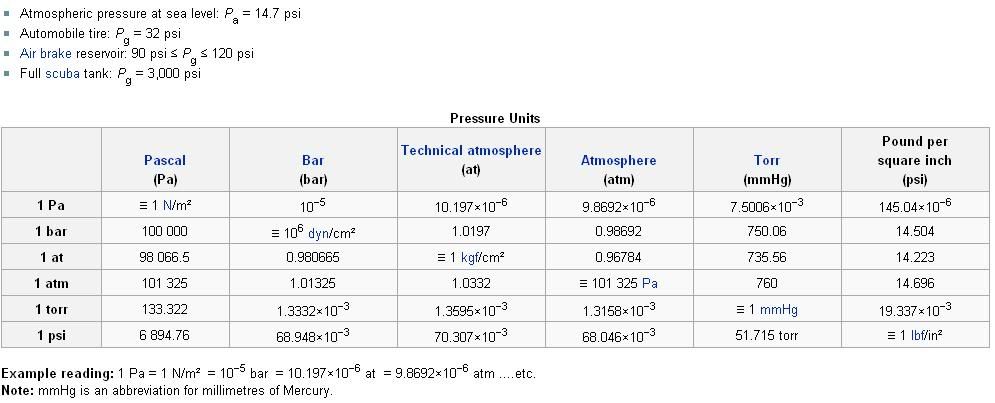
[color="DarkRed"]PSI:[/color]
The pound-force per square inch (symbol: lbf/in²) is a non-SI unit of pressure based on avoirdupois units. In casual English language use it is rendered as "pounds per square inch", abbreviated to psi with little distinction between "mass" and "force"
Image
[color="DarkRed"]Simpel Papiamento Criyoyo: PSI tin di haber cu e cantidad presion di aire cun turbo of supercharger ta produci ora di boost (spera mi a splike bon y simpel)[/color]

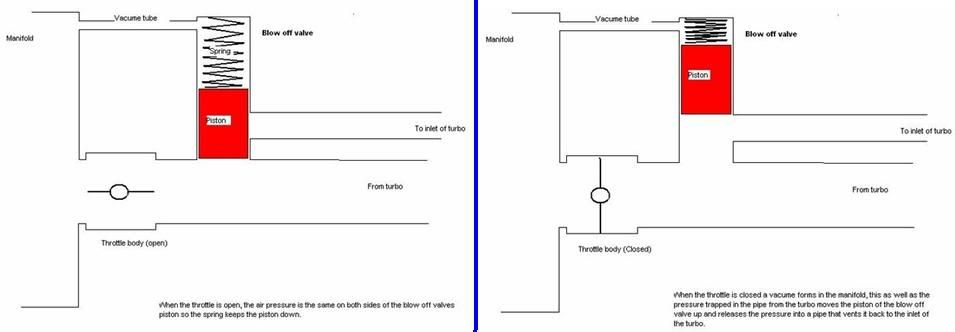
[color="DarkGreen"]B.O.V. (Blow-off valve)[/color]
A blowoff valve (also known as a bypass valve, compressor relief valve, or sometimes hooter valve) is a vacuum operated valve that is located in the intake tract on an internal combustion engine after a turbocharger, but before the throttle body butterfly valve and intake manifold. Its use is to vent extra pressure being developed by the turbocharger when the throttle is closed, such as during a shift. During a shift in a car with a manual transmission, the throttle plate is closed. The pressure produced by the turbocharger has nowhere to escape to. This excess pressure could potentially cause damage to the turbocharger's impeller and may also slow or even stop it, thus causing turbo lag when the throttle is pressed again

Image
A blowoff valve is connected by a vacuum hose to the intake manifold after the throttle plate. When the throttle is closed, a strong vacuum develops in the intake manifold after the throttle plate and "sucks" the blowoff valve open. The excess pressure from the turbocharger is vented into the atmosphere or recirculated into the intake upstream of the compressor inlet; when vented into the atmosphere this can cause erratic engine behavior on motors that use an air flow meter for the electronic fuel injection. Engines using a MAP (manifold absolute pressure) are not affected. Externally-vented blowoff valves have a very distinguished "psshh" sound that is desired by many who own turbocharged sports cars. Some blowoff valves are marketed with trumpet shaped exits that amplify the "psshh" sound.

Blowoff valves are generally not required on automatic transmission vehicles. Automatic transmission vehicles shift without closing the throttle, but are still fitted with blow off valves by many manufacturers so the turbo is able to provide boost sooner if the throttle is only released for a short amount of time.

[color="DarkGreen"]Simpel Papiamento: Esaki ta hasi e whoosh sound cu bo ta tende ora un auto turbocharged cambia speed, e bov ta release e aire di mas cu ta acumula na e intake side[/color]

[color="Indigo"]WASTEGATE[/color]
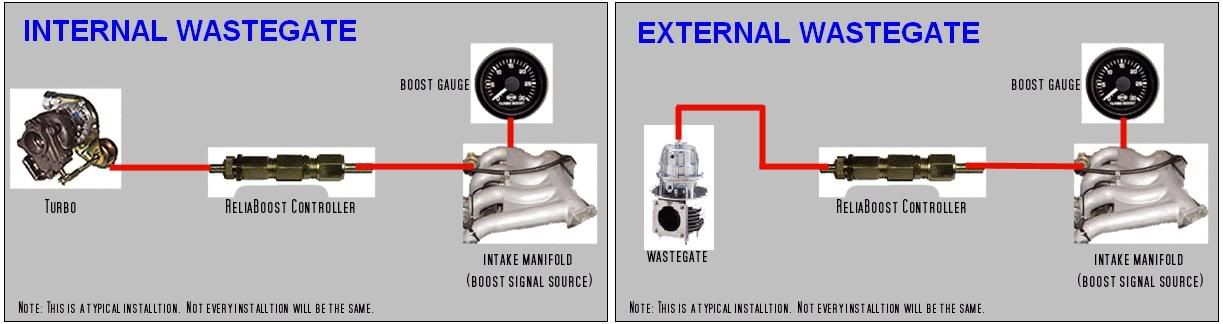
A wastegate is a valve that diverts exhaust gases away from the turbine wheel in a turbocharger. Diversion of exhaust gases causes the turbine to lose speed, which in turn reduces the rotating speed of the compressor. The primary function of the wastegate is to stabilize boost pressure in turbocharger systems. The wastegate is controlled pneumatically by a wastegate actuator.
Image

Contents
Wastegate types
1 Internal
2 External
3 Atmospheric/Divorced Wastegates


Wastegate types

InternalAn internal wastegate is an integral part of the turbine housing. The wastegate actuator is commonly attached to the compressor housing with a metal bracket.

External
An external wastegate is a separate self-contained mechanism designed for turbochargers that don't have internal wastegates. An external wastegate requires a specially constructed turbo manifold with a dedicated runner going to the wastegate. The external wastegate can also be mounted off a o2 housing, or it may be part of the exhaust housing itself. External wastegates are commonly used for regulating boost levels more precisely than internal wastegates in high power applications, where high boost levels can be achieved.

Atmospheric/Divorced Wastegates
These terms refer to the handling of the gases after they leave the wastegate, instead of the wastegate mechanism itself. A divorced wastegate dumps the gases directly into the atmosphere, instead of returning it with the rest of an engine's exhaust. This is done to prevent turbulence to the exhaust flow.

[color="Indigo"]Simpel Papiamento: Aire cu e turbo ta manda di mas , e wastegate ta zorg pa sake afo den atmosfeer of exhaust (mi ta kere cu ta asina anto)[/color]
Image
User avatar
GT-R34
Posts: 763
Joined: Mon Apr 21, 2003 5:02 pm
Location: Aruba

Post by GT-R34 »

Bon info man , asina ki cos mester ta no
Loved By Few, Hated By Many and Feared By All.
User avatar
GinoX
RaceJunkies B*tch
Posts: 5180
Joined: Thu Apr 24, 2003 7:58 am
Location: aruba

Post by GinoX »

Thanx DSM. Awo mi sa ken ta Pascal.....
:2cents: The make up of any "culture" must evolve or die.....
The roots remain...
but as with anything(everthing) else it is up to those who are the future to shape the future.

ImageImage :laffin: Image
User avatar
J-Tuning
RaceJunkies B*tch
Posts: 2179
Joined: Fri May 02, 2003 7:55 am
Location: Planet Earth
Contact:

Post by J-Tuning »

nice thread thnx
User avatar
Patrick
Race Junkies Devotee
Posts: 110
Joined: Sun Dec 05, 2004 12:22 pm
Location: Oranjestad, Aruba

Post by Patrick »

Usefull information, thx.
User avatar
Chai
RaceJunkies B*tch
Posts: 3070
Joined: Mon Jun 13, 2005 3:31 pm
Location: Aruba
Contact:

Post by Chai »

[color="DarkRed"]W.O.T.[/color] Wide Open Throttle

Wide Open Throttle (WOT) refers to an internal combustion engine's maximum intake of air and fuel that occurs when the throttle plates inside the carburetor or throttle body are "wide open", providing the least resistance to the incoming air. In the case of an automobile, WOT is when the accelerator depressed fully.

At WOT, manifold vacuum decreases. Ideally, to preserve driveability and fuel economy, manifold vacuum should not fall any lower than 1" (mercury).

[color="Blue"]TURBO[/color] MI CU ESAKI TA HOPI PA LESA, PERO MESTER SPLIKE UITGEBREID
A turbocharger is an exhaust gas driven compressor used in internal-combustion engines to increase the power output of the engine by increasing the mass of oxygen entering the engine. A key advantage of turbochargers is that they offer a considerable increase in engine power with only a slight increase in weight.

Principle of operation
A turbocharger is an exhaust gas driven supercharger. All superchargers have a gas compressor in the intake tract of the engine which compresses the intake air above atmospheric pressure, greatly increasing the volumetric efficiency beyond that of naturally-aspirated engines. A turbocharger also has a turbine that powers the compressor using wasted energy from the exhaust gases. The compressor and turbine spin on the same shaft, similar to a turbojet aircraft engine.

The term supercharger is very often used when referring to a mechanically driven turbocharger, which is most often driven from the engine's crankshaft by means of a belt (otherwise, and in many aircraft engines, by a geartrain), whereas a turbocharger is exhaust-driven, the name turbocharger being a contraction of the earlier "turbosupercharger". Because the turbine of a turbocharger is in-itself a heat engine, a turbocharger equipped engine will normally compress the intake air more efficiently than a mechanical supercharger. But because of "turbo lag" (see below), engines with mechanical superchargers are typically more responsive.

The compressor increases the pressure of the air entering the engine, so a greater mass of oxygen enters the combustion chamber in the same time interval (an increase in fuel is required to keep the mixture the same air to fuel ratio). This greatly improves the volumetric efficiency of the engine, and thereby creates more power. The additional fuel is provided by the proper tuning of the fuel injectors or carburetor.

The increase in pressure is called "boost" and is measured in pascals, bars or lbf/in². The energy from the extra fuel leads to more overall engine power. For example, at 100% efficiency a turbocharger providing 101 kPa (14.7 lbf/in²) of boost would effectively double the amount of air entering the engine because the total pressure is twice atmospheric pressure. However, there are some parasitic losses due to heat and exhaust backpressure from the turbine, so turbochargers are generally only about 80% efficient, at peak efficiency, because it takes some work for the engine to push those gases through the turbocharger turbine (which is acting as a restriction in the exhaust) and the now-compressed intake air has been heated, reducing its density.

For automobile use, typical boost pressure is in the general area of 80 kPa (11.6 lbf/in²), but it can be much more. Because it is a centrifugal pump, a typical turbocharger, depending on design, will only start to deliver boost from a certain rpm where the engine starts producing enough exhaust gas to spin the turbocharger fast enough to make pressure. This engine rpm is referred to as the boost threshold. Another fact to observe is that the relation between boost pressure and compressor rpm is somewhat exponential, and the relation between compressor rpm and airflow is very small. A turbocharger that's pushing 15psi when the engine is at 3000rpm will only have increased a little bit in speed when maintaining the same pressure at 6000 engine rpm; given that it is still within the design limits of the compressor. For this very same reason, belt driven centrifugal superchargers have a very narrow power band and deliver max boost only when the engine is at max rpm.

A disadvantage in gasoline engines is that the compression ratio should be lowered (so as not to exceed maximum compression pressure and to prevent engine knocking) which reduces engine efficiency when operating at low power. This disadvantage does not apply to specifically designed turbocharged diesel engines. However, for operation at altitude, the power recovery of a turbocharger makes a big difference to total power output of both engine types. This last factor makes turbocharging aircraft engines considerably advantageous—and was the original reason for development of the device.

A main disadvantage of high boost pressures for internal combustion engines is that compressing the inlet air increases its temperature. This increase in charge temperature is a limiting factor for petrol engines that can only tolerate a limited increase in charge temperature before detonation occurs. The higher temperature is a volumetric efficiency downgrade for both types of engine. The pumping-effect heating can be alleviated by aftercooling (sometimes called intercooling).


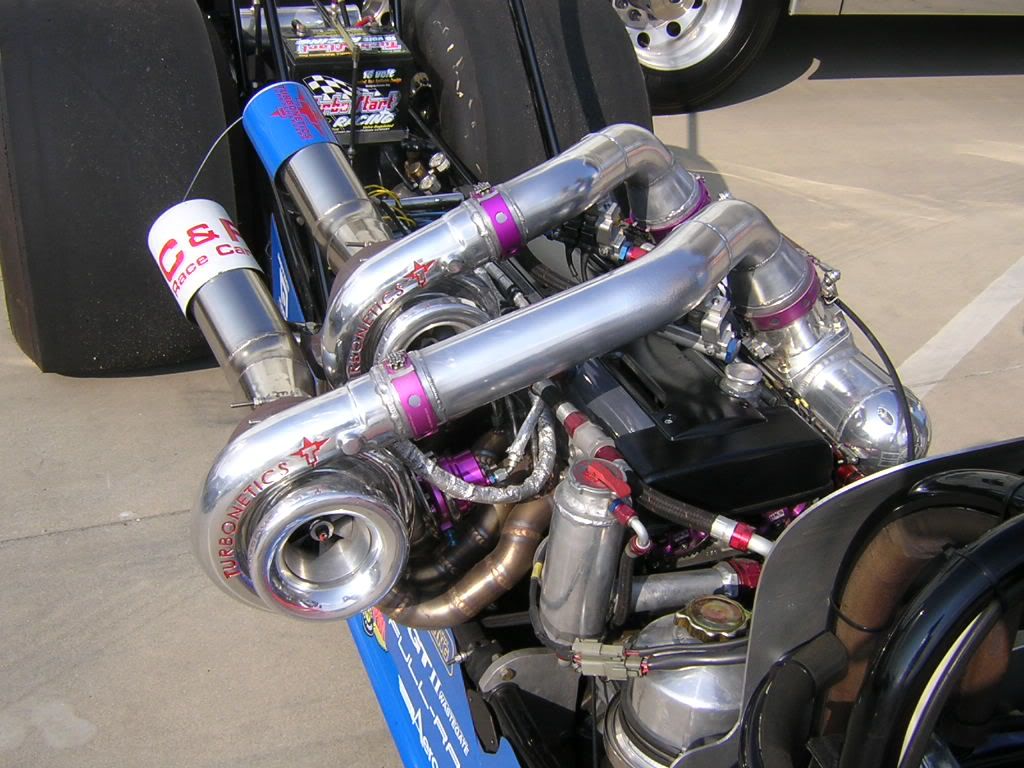
A Pair of turbochargers mounted to an Inline 6 engine in a dragster
Image
Image
User avatar
Chai
RaceJunkies B*tch
Posts: 3070
Joined: Mon Jun 13, 2005 3:31 pm
Location: Aruba
Contact:

Post by Chai »

[color="Blue"]TURBO (Continued)[/color]
Design details
When a gas is compressed, its temperature rises. It is not uncommon for a turbocharger to be pushing out air that is 90 °C (200°F). Compressed air from a turbo may be (and most commonly is, on petrol engines) cooled before it is fed into the cylinders, using an intercooler or a charge air cooler (a heat-exchange device).

A turbo spins very fast; most peak between 80,000 and 150,000 rpm (using low inertia turbos, 190,000 rpm) depending on size, weight of the rotating parts, boost pressure developed and compressor design. Such high rotation speeds would cause problems for standard ball bearings leading to failure so most turbo-chargers use fluid bearings. These feature a flowing layer of oil that suspends and cools the moving parts. The oil is usually taken from the engine-oil circuit and usually needs to be cooled by an oil cooler before it circulates through the engine. Some turbochargers use incredibly precise ball bearings that offer less friction than a fluid bearing but these are also suspended in fluid-dampened cavities. Lower friction means the turbo shaft can be made of lighter materials, reducing so-called turbo lag or boost lag. Some car makers use water cooled turbochargers for added bearing life.

Turbochargers with foil bearings are in development which eliminates the need for bearing cooling or oil delivery systems.

To manage the upper-deck air pressure, the turbocharger's exhaust gas flow is regulated with a wastegate that bypasses excess exhaust gas entering the turbocharger's turbine. This regulates the rotational speed of the turbine and the output of the compressor. The wastegate is opened and closed by the compressed air from turbo (the upper-deck pressure) and can be raised by using a solenoid to regulate the pressure fed to the wastegate membrane. This solenoid can be controlled by Automatic Performance Control, the engine's electronic control unit or an after market boost control computer. Another method of raising the boost pressure is through the use of check and bleed valves to keep the pressure at the membrane lower than the pressure within the system.

Some turbochargers utilise a set of vanes in the exhaust housing to maintain a constant gas velocity across the turbine, the same kind of control as used on power plant turbines. These turbochargers have minimal amount of lag, have a low boost threshold, and are very efficient at higher engine speeds. In many setups these turbos don't even need a wastegate. The vanes are controlled by a membrane identical to the one on a wastegate but the level of control required is a bit different. The first car manufacturer to use these turbos was the limited-production 1989 Shelby CSX-VNT. It utilised a turbo from Garrett, called the VNT-25 because it uses the same compressor and shaft as the more common Garrett T-25. This type of turbine is called a Variable Nozzle Turbine (VNT). Turbocharger manufacturer Aerocharger uses the term 'Variable Area Turbine Nozzle' (VATN) to describe this type of turbine nozzle. Another common term is Variable Turbine Geometry.

Reliability
As long as the oil supply is clean and the exhaust gas does not become overheated (lean mixtures or retarded spark timing on a gasoline engine) a turbocharger can be very reliable but care of the unit is important. Replacing a turbo that lets go and sheds its blades will be expensive. The use of synthetic oils is recommended in turbo engines.

After high speed operation of the engine it is important to let the engine run at idle speed for one to three minutes before turning off the engine. Saab, in its owner manuals, recommends a period of just 30 seconds. This lets the turbo rotating assembly cool from the lower exhaust gas temperatures. Not doing this will also result in the critical oil supply to the turbocharger being severed when the engine stops while the turbine housing and exhaust manifold are still very hot, leading to coking (burning) of the lubricating oil trapped in the unit when the heat soaks into the bearings and later, failure of the supply of oil when the engine is next started causing rapid bearing wear and failure. Even small particles of burnt oil will accumulate and lead to choking the oil supply and failure. A turbo timer is a device designed to keep an automotive engine running for a pre-specified period of time, in order to execute this cool-down period automatically.

Turbos with watercooled bearing cartridges have a protective barrier against coking. The water boils in the cartridge when the engine is shut off and forms a natural recirculation to drain away the heat. It is still a good idea to not shut the engine off while the turbo and manifold are still glowing.

In custom applications utilising tubular headers rather than cast iron manifolds, the need for a cooldown period is reduced because the lighter headers store much less heat than heavy cast iron manifolds.

Diesel engines are usually much kinder to turbos because their exhaust gas temperature is much lower than that of gasoline engines and because most operators allow the engine to idle and do not switch it off immediately after heavy use.
Image
User avatar
Chai
RaceJunkies B*tch
Posts: 3070
Joined: Mon Jun 13, 2005 3:31 pm
Location: Aruba
Contact:

Post by Chai »

[color="Blue"]TURBO (Continued)[/color]

LAG
A lag is sometimes felt by the driver of a turbocharged vehicle as a delay between pushing on the accelerator pedal and feeling the turbo kick-in. This is symptomatic of the time taken for the exhaust system driving the turbine to come to high pressure and for the turbine rotor to overcome its rotational inertia and reach the speed necessary to supply boost pressure. The directly-driven compressor in a positive-displacement supercharger does not suffer this problem. (Centrifugal superchargers do not build boost at low RPM's like a positive displacement supercharger will). Conversely on light loads or at low rpm a turbocharger supplies less boost and the engine is more efficient than a supercharged engine.

Lag can be reduced by lowering the rotational inertia of the turbine, for example by using lighter parts to allow the spool-up to happen more quickly. Ceramic turbines are a big help in this direction. Unfortunately, their relative fragility limits the maximum boost they can supply. Another way to reduce lag is to change the aspect ratio of the turbine by reducing the diameter and increasing the gas-flow path-length. Increasing the upper-deck air pressure and improving the wastegate response help but there are cost increases and reliability disadvantages that car manufacturers are not happy about. Lag is also reduced by using a precision bearing rather than a fluid bearing, this reduces friction rather than rotational inertia but contributes to faster acceleration of the turbo's rotating assembly.

Another common method of equalizing turbo lag, is to have the turbine wheel "clipped", or to reduce the surface area of the turbine wheel's rotating blades. By clipping a minute portion off the tip of each blade of the turbine wheel, less restriction is imposed upon the escaping exhaust gases. This imparts less impedance onto the flow of exhaust gasses at low rpm, allowing the vehicle to retain more of its low-end torque, but also pushes the effective boost rpm to a slightly higher level. The amount a turbine wheel is and can be clipped is highly application-specific. Turbine clipping is measured and specified in degrees.

Other setups, most notably in V-type engines, utilize two identically-sized but smaller turbos, each fed by a separate set of exhaust streams from the engine. The two smaller turbos produce the same (or more) aggregate amount of boost as a larger single turbo, but since they are smaller they reach their optimal rpm, and thus optimal boost delivery, faster. Such an arrangement of turbos is typically referred to as a "twin turbo" setup.

Some car makers combat lag by using two small turbos (like Toyota, Subaru, Maserati, Mazda, and Audi). A typical arrangement for this is to have one turbo active across the entire rev range of the engine and one coming on-line at higher rpm. Early designs would have one turbocharger active up to a certain rpm, after which both turbochargers are active. Below this rpm, both exhaust and air inlet of the secondary turbo are closed . Being individually smaller they do not suffer from excessive lag and having the second turbo operating at a higher rpm range allows it to get to full rotational speed before it is required. Such combinations are referred to as "sequential turbos". Sequential turbochargers are usually much more complicated than single or twin-turbocharger systems because they require what amounts to three sets of pipes-intake and wastegate pipes for the two turbochargers as well as valves to control the direction of the exhaust gases. An example of this is the current BMW E60 5-Series 535d. Many new diesel engines use this technology to not only eliminate lag but also to reduce fuel consumption and cleaner emissions. An example of this would be the Ford Power Stroke engine.

Lag is not to be confused with the boost threshold, however many publications still make this basic mistake. The boost threshold of a turbo system describes the minimum turbo rpm at which the turbo is physically able to supply the requested boost level. Newer turbocharger and engine developments have caused boost thresholds to steadily decline to where day-to-day use feels perfectly natural. Putting your foot down at 1200 engine rpm and having no boost until 2000 engine rpm is an example of boost threshold and not lag.

Race cars often utilise anti-lag to completely eliminate lag at the cost of reduced turbocharger life.

On modern diesel engines, this problem is virtually eliminated by utilising a variable geometry turbocharger. The newly presented Porsche 911 Turbo has eliminated this problem for gasoline engines as well.

BOOST
Boost refers to the increased manifold pressure that is generated by the intake side turbine. This is limited to keep the turbo inside its design operating range by controlling the wastegate which shunts the exhaust gases away from the exhaust side turbine. Many diesel engines do not have any wastegate because the amount of exhaust energy is controlled directly by the amount of fuel injected into the engine, and slight variations in boost pressure do not make a difference for the engine.
Image
User avatar
Chai
RaceJunkies B*tch
Posts: 3070
Joined: Mon Jun 13, 2005 3:31 pm
Location: Aruba
Contact:

Post by Chai »

[color="Blue"]TURBO (Continued)[/color]
Applications
Turbocharging is very common on diesel engines in conventional automobiles, in trucks, for marine and heavy machinery applications. In fact, for current automotive applications, non-turbocharged diesel engines are becoming increasingly rare. Diesels are particularly suitable for turbocharging for several reasons:

Naturally-aspirated diesels have lower power-to-weight ratios compared to gasoline engines; turbocharging will improve this P:W ratio.
Diesel engines require more robust construction because they already run at very high compression ratio and at high temperatures so they generally require little additional reinforcement to be able to cope with the addition of the turbocharger. Gasoline engines often require extensive modification for turbocharging.
Diesel engines have a narrower band of engine speeds at which they operate, thus making the operating characteristics of the turbocharger over that "rev range" less of a compromise than on a gasoline-powered engine.
Diesel engines blow nothing but air into the cylinders during cylinder charging, squirting fuel into the cylinder only after the intake valve has closed and compression has begun. Gasoline/petrol engines differ from this in that both fuel and air are introduced during the intake cycle and both are compressed during the compression cycle. The higher intake charge temperatures of forced-induction engines reduces the amount of compression that is possible with a gasoline/petrol engine, whereas diesel engines are far less sensitive to this.

Today, turbocharging is most commonly used on two types of engines: Gasoline engines in high-performance automobiles and diesel engines in work trucks. Small cars in particular benefit from this technology, as there is often little room to fit a larger-output (and physically larger) engine. Saab has been the leading car maker using turbochargers in production cars, starting with the 1978 Saab 99. The Porsche 944 utilized a turbo unit in the 944 Turbo (Porsche internal model number 951), to great advantage, bringing its 0-100 km/h (0-60 mph) times very close to its contemporary non-turbo "big brother", the Porsche 928. Contemporary examples of turbocharged performance cars include the Dodge SRT-4, Volkswagen GTI, Subaru Impreza WRX, Mazda RX-7, Mitsubishi Lancer Evolution, Nissan Skyline GT-R, Toyota Supra RZ, and the Porsche 911 Turbo.

Small car turbos are increasingly being used as the basis for small jet engines used for flying model aircraft—though the conversion is a highly specialised job—one not without its dangers.

Most modern turbocharged aircraft use an adjustable wastegate. The wastegate is controlled manually, or by a pneumatic/hydraulic control system, or, as is becoming more and more common, by a flight computer. In the interests of engine longevity, the wastegate is usually kept open, or nearly so, at sea-level to keep from overboosting the engine. As the aircraft climbs, the wastegate is gradually closed, maintaining the manifold pressure at or above sea-level. In aftermarket applications, aircraft turbochargers sometimes do not overboost the engine, but rather compress ambient air to sea-level pressure. For this reason, such aircraft are sometimes refered to as being turbo-normalised. Most applications produced by the major manufacturers (Beech, Cessna, Piper and others) increase the maximum engine intake air pressure by as much as 35%. Special attention to engine cooling and component strength is required because of the increased combustion heat and power.

Turbo-Alternator[1] is a form of turbocharger that generates electricity instead of boosting engine's air flow. On September 21, 2005, Foresight Vehicle announced the first known implementation of such unit for automobiles, under the name TIGERS (Turbo-generator Integrated Gas Energy Recovery System).[2]

HISTORY
The turbocharger was invented by Swiss engineer, Alfred Buchi, who had been working on steam turbines. His patent for the internal combustion turbocharger was applied for in 1905. Diesel ships and locomotives with turbochargers began appearing in the 1920s.

One of the first applications of a turbocharger to a non-Diesel engine came when General Electric engineer, Sanford Moss attached a turbo to a V12 Liberty aircraft engine. The engine was tested at Pike's Peak in Colorado at 14,000 feet to demonstrate that it could eliminate the power losses usually experienced in internal combustion engines as a result of altitude.

Turbochargers were first used in production aircraft engines in the 1930s prior to World War II. The primary purpose behind most aircraft-based applications was to increase the altitude at which the airplane can fly, by compensating for the lower atmospheric pressure present at high altitude. Aircraft such as the Lockheed P-38 Lightning, Boeing B-17 Flying Fortress and B-29 Superfortress all used exhaust driven "turbo-superchargers" to increase high altitude engine power. It is important to note that turbosupercharged aircraft engines actually utilized a gear-driven centrifugal type supercharger in series with a turbocharger.

Turbo-Diesel trucks were produced in Europe and America (notably by Cummins) after 1949. The turbocharger hit the automobile world in 1952 when Fred Agabashian qualified for pole position at the Indianapolis 500 and led for 100 miles before tire shards disabled the blower.

The first production turbocharged automobile engines came from General Motors. The A-body Oldsmobile Cutlass Jetfire and Chevrolet Corvair Monza Spyder were both fitted with turbochargers in 1962. The Oldsmobile is often recognized as the first, since it came out a few months earlier than the Corvair. Its Turbo Jetfire was a 215 in³ (3.5 L) V8, while the Corvair engine was either a 145 in³ (2.3 L)(1962-63) or a 164 in³ (2.7 L) (1964-66) flat-6. Both of these engines were abandoned within a few years, and GM's next turbo engine came more than two decades later.

Offenhauser's turbocharged engines returned to Indianapolis in 1966, with victories coming in 1968. The Offy turbo peaked at over 1,000 hp in 1973, while Porsche dominated the Can-Am series with a 1100 hp 917/30. Turbocharged cars dominated the Le Mans between 1976 and 1994.

BMW led the resurgence of the automobile turbo with the 1973 2002 Turbo, with Porsche following with the 911 Turbo, introduced at the 1974 Paris Motor Show. Buick was the first GM division to bring back the turbo, in the 1978 Buick Regal, followed by the famed Mercedes-Benz 300D and Saab 99 in 1978. Pontiac also introduced a turbo in 1980 and Volvo Cars followed in 1981.

In Formula 1, in the so called "Turbo Era" of 1977 until 1989, engines with a capacity of 1500 cc could achieve anywhere from 1000 to 1500 hp (746 to 1119 kW) (Renault, Honda, BMW). Renault was the first manufacturer to apply turbo technology in the F1 field, in 1977. The project's high cost was compensated for by its performance, and led to other engine manufacturers following suit. The Turbo-charged engines took over the F1 field and ended the Ford Cosworth DFV era in the mid 1980s
Image
User avatar
Chai
RaceJunkies B*tch
Posts: 3070
Joined: Mon Jun 13, 2005 3:31 pm
Location: Aruba
Contact:

Post by Chai »

[color="Blue"]PISTON[/color]
In general, a piston is a sliding plug that fits closely inside the bore of a cylinder.

Image
Its purpose is either to change the volume enclosed by the cylinder, or to exert a force on a fluid inside the cylinder.

Internal combustion engine
Most pistons fitted in a cylinder have piston rings. Usually there are two spring-compression rings that act as a seal between the piston and the cylinder wall, and one or more oil control rings below the compression rings. The head of the piston can be flat, bulged or otherwise shaped. Pistons can be forged or cast. The shape of the piston is normally rounded, but can be different. A special type of cast piston is the hypereutectic piston. The piston is an important component of a piston engine and of hydraulic pneumatic systems.

In an Otto or Diesel engine, the head of the piston forms one wall of an expansion chamber inside the cylinder. The opposite wall, called the cylinder head, contains inlet and exhaust valves for gases.

As the piston moves inside the cylinder, it transforms the energy from the expansion of a burning gas (usually a mixture of petrol or diesel and air) into mechanical power (in the form of a reciprocating linear motion). From there the power is conveyed through a connecting rod to a crankshaft, which transforms it into a rotary motion, which usually drives a gearbox through a clutch.

Ways of making power
There are two ways that a piston engine can make power. These are the two-stroke cycle and the four-stroke cycle. A two stroke engine produces power every stroke. A two stroke engine produces more pollution than a four stroke engine, which produces power every other stroke. In theory, a four stroke engine has to be larger than a two stroke engine to produce an equivalent amount of power. Two stroke engines are becoming less common these days, mainly due to air pollution. Two stroke engines usually need more maintenance and tend to wear out faster than four stroke engines.


External combustion engine
A steam engine is another type of piston engine. In most steam engines, the pistons are double acting: steam is alternately admitted to either end of the cylinder, so that every piston stroke produces power

[color="Blue"]Hypereutectic pistons[/color]

Hypereutectic pistons are cast pistons made from aluminum with over 16% silicon content for strength and durability. The term 'hypereutectic' comes from eutectic.

Special melting processes are necessary to ‘supersaturate’ the aluminum with additional silicon content. Special molds, casting and cooling techniques are required to obtain finely and uniformly dispersed silicon particles throughout the material.

These newer pistons are very hard, thus brittle. They have proven to be un-forgiving with engine knocking. For this reason they are great in naturally-aspirated engines, but should be used with caution for 'nitrous', super- or turbochargers. Generally speaking, forged pistons are a better choice for high boost.

Hypereutectic pistons are used in many original equipment engines. They are favored because of reduced scuffing, improved power, fuel economy and emissions. The reduced thermal expansion rate allows the piston to be run with reduced clearance
Image
User avatar
Chai
RaceJunkies B*tch
Posts: 3070
Joined: Mon Jun 13, 2005 3:31 pm
Location: Aruba
Contact:

Post by Chai »

FUEL INJECTION
Fuel Injection is a method or system for metering fuel into an internal combustion engine. The fuel is then burned in air to produce heat, which in turn is converted to mechanical work by the engine. In modern automotive applications, fuel injection is typically only one of several important tasks performed by an engine management system.
For gasoline engines, carburetors were the predominant method to meter fuel prior to the widespread use of fuel injection, however various fuel injection schemes have existed since the earliest usage of the internal combustion engine.
Prior to 1980, nearly all gasoline engines used carburetors. Since 1990, almost all gasoline passenger cars sold in the United States use electronic fuel injection (EFI).
The functional objectives for fuel injection systems can vary. All share the central task of supplying fuel to the combustion process in the engine, but it is a design decision whether a particular system will be optimized for power, fuel economy, low emissions, special fuels, durability, smooth behavior ("driveability"), or other objectives. Because some of these goals are conflicting, it is impossible to optimize a single system for every goal simultaneously. For example, maximizing fuel economy or power comes at the price of somewhat higher exhaust emissions. In practice, automotive engineers strive to provide an all-round blend of competing goals to best satisfy customers, all while complying with emission regulations.
An EFI system costs more than a carburetor system, but a greater number of the competing objectives can be better optimized with EFI than a carburetor.

Contents
1 Benefits
2 Regulatory Motivation
3 Basic Function
4 Type of Fuel
5 Detailed Function
5.1 Typical EFI Components
5.2 Functional Description
5.3 Sample Pulsewidth Calculations
5.3.1 Calculate Injector Pulsewidth From Airflow
5.3.2 Calculate Fuel-Flow Rate From Pulsewidth
6 Various Injection Schemes
6.1 Throttle Body Injection (TBI or CFI)
6.2 Continuous Injection
6.3 Central Port Injection (CPI)
6.4 Sequential Central Point Injection (SCPI)
6.5 Multi-Port Fuel Injection (PFI or EFI or SEFI)
6.6 Direct Injection
7 Evolution
7.1 Pre-Emission Era
7.2 Post Emission Era
8 External links

Benefits
An engine’s air/fuel ratio must be accurately controlled under all operating conditions to achieve the desired engine performance, emissions, driveability and fuel economy. Modern EFI systems meter fuel with great precision, and when used in conjunction with an Exhaust Gas Oxygen Sensor (EGO sensor), they are also very accurate. The advent of digital closed loop fuel control, based on feedback from an EGO sensor, permit EFI to significantly out perform a carburetor. The two fundamental improvements are:

1.Reduced response time to rapidly changing inputs, e.g., rapid throttle movements.
2.Deliver an accurate and equal mass of fuel to each cylinder of the engine, dramatically improving the cylinder-to-cylinder distribution of the engine.

These two features result in the following performance benefits:
•Exhaust Emissions
- Significantly reduced "engine out" or "feedgas" emissions (the chemical products of engine combustion).
- A reduction in the final tailpipe emissions (≈ 0.99%) resulting from the ability to accurately condition the "feedgas" in a manner that maximizes the effectiveness of the catalytic converter.
•General Engine Operation
- Smoother function during quick throttle transitions.
- Engine starting.
- Extreme weather operation.
- Reduced maintenance interval.
- A slight increase in fuel economy.
•Power Output
- Fuel injection often produces more power than an equivalent carbureted engine. However, fuel injection alone does not increase maximum engine output. Increased airflow is necessary to permit oxidizing more fuel, which generates more heat, which in turn generates more output. The combustion process converts the fuel's chemical energy into heat energy, whether the fuel arrived via EFI or a carburetor is not significant. Airflow is often improved with fuel injectors, which are much smaller than a carburetor. Their smaller size permits more design freedom to improve the air's path into the engine. In contrast, a carburetor's mounting options are limited because it is larger, it must be carefully oriented with respect to gravity, and it must be approximately equal distance from each of the engine's cylinders. These design constraints generally compromise airflow into the engine.
- A carburetor relies on a drag inducing venturi in order to create a local air pressure difference, which forces the fuel into the air stream. The flow loss caused by the venturi is small in comparison to other flow losses in the induction system. In a well-designed carbureted induction system, the venturi in and of itself is not a significant airflow restriction.
- Fuel injection is more likely to increase efficiency than power. When cylinder-to-cylinder fuel distribution is improved (common with EFI), less fuel is required to generate the same power output. Engine efficiency is known as the BSFC, or brake specific fuel consumption. When cylinder-to-cylinder distribution is less than ideal (and it always is under one condition or another, and worse on carburetor systems), more fuel than necessary is metered to the rich cylinders in order to provide sufficient fuel to the lean cylinders. Power output is asymmetrical with respect to air/fuel ratio. In other words, burning extra fuel in the rich cylinders does not reduce power nearly as quickly as burning too little fuel in the lean cylinders. The standard fuel metering compromise is to run the rich cylinders "even richer" of the optimal air/fuel ratio, in order to provide enough fuel to the leaner cylinders. The net power output improves with all the cylinders making maximum power. An analogy is that of painting a wall. One coat of paint may not cover very well. The second coat dramatically improves the appearance of the poorly covered areas, but some extra paint is consumed on areas that were already well covered.
- Deviations from perfect air/fuel distribution, however subtle, significantly impact emissions, by forfeiting combustion events at the chemically ideal, stoichiometric air/fuel ratio. Grosser distribution problems eventually begin to negatively impact efficiency, and the grossest distribution issues finally affect power. The hierarchy of negative functional impact with regard to increasingly poorer air/fuel distribution is: emissions, efficiency, and power.
Injection systems have evolved significantly since the mid 1980s. Current EFI systems provide an accurate and cost effective method of metering fuel. The emission and subjective performance characteristics have steadily improved with the advent of modern digital controls, which is why EFI systems have replaced carburetors in the marketplace.

EFI is becoming more reliable and less expensive through widespread usage. At the same time, carburetors are becoming less available, and more expensive. Even marine applications are adopting EFI as reliability improves. If this trend continues, it is conceivable that virtually all internal combustion engines, including garden equipment and snow throwers, will eventually use EFI.

It should be noted that a carburetor's fuel metering system is a less expensive alternative when strict emission regulations are not a requirement, as is the case in developing countries. EFI will undoubtedly replace carburetors in these nations too as they adopt emission regulations similar to Europe, Japan and North America.

Regulatory Motivation
Throughout the 1950's and 1960's, various branches of United States federal, state and local governments conducted studies into the numerous sources of air pollution. These studies ultimately attributed a significant portion of existing air pollution to the automobile, and concluded air pollution is not bounded by local geographical or political boundaries. The limited scope local pollution regulations were gradually superseded with more strategically comprehensive, and therefore more effective, state and federal regulations. By 1967 the state of California (Governor Reagan), created the Air Resources Board (http://www.arb.ca.gov), and in 1970 the U.S. Environmental Protection Agency was formed. Both agencies now create and enforce emission regulations from automobiles, as well as most other man-made sources.
Additionally, similar studies and regulations were simultaneously being developed in Europe and Japan.
The primary source of internal combustion engine emissions is the incomplete combustion of a minute fraction of the total fuel consumed. The unburned portion of fuel is so small, the lost energy is trivial to fuel efficiency, and therefore commercially insignificant to the final customer. Auto manufacturers were finally motivated by various regulations worldwide to address the emission issue.
The modern EFI system evolved to achieve deliberate control of the small fraction of unburned fuel. The ideal combustion goal is to match each molecule of fuel with a corresponding molecule of oxygen so that neither has any molecules remaining after combustion, (see stoichiometry). This is a gross oversimplification of complex combustion chemistry, that occurs in a complex environment. However, it accurately describes the magnitude of the control task, and therefore the desired precision of a modern EFI system.

Image
User avatar
Ladcho
RaceJunkies B*tch
Posts: 1201
Joined: Tue Oct 25, 2005 4:04 pm
Location: Aruba
Contact:

Post by Ladcho »

REQUEST: Timing..Cams..Adjustable Cam Degree..and how and why???
Image Image

"Diplomacy is the art of saying 'Nice doggie' until you can find a rock....
User avatar
Chai
RaceJunkies B*tch
Posts: 3070
Joined: Mon Jun 13, 2005 3:31 pm
Location: Aruba
Contact:

Post by Chai »

[color="Blue"]FUEL INJECTORS (Continued)[/color]

Basic Function
The fuel injector acts as the fuel-dispensing nozzle. It injects liquid fuel directly into the engine's air stream. In almost all cases this requires an external pump. The pump and injector are only two of several components in a complete fuel injection system.
The process of determining the amount of fuel, and its delivery into the engine, are known as fuel metering. Early injection systems used mechanical methods to meter fuel (non electronic, or mechanical fuel injection). Modern systems are nearly all electronic, and use an electronic solenoid (the injector) to inject the fuel. A CPU calculates the mass of fuel to inject.
In contrast to an EFI system, a carburetor directs the induction air through a venturi, which generates a minute difference in air pressure. The minute air pressure differences both emulsify (premix fuel with air) the fuel, and then acts as the force to push the mixture from the carburetor nozzle into the induction air stream. As more air enters the engine, a greater pressure difference is generated, and more fuel is metered into the engine. A carburetor is a self-contained fuel metering system, and is cost competitive when compared to a complete EFI system.
An EFI system requires several peripheral components in addition to the injector(s), in order to duplicate all the functions of a carburetor. A point worth noting during times of fuel metering repair is that EFI systems are prone to diagnostic ambiguity. A single carburetor replacement can accomplish what might require numerous repair attempts to identify which one of the several EFI system components is malfunctioning. On the other hand, EFI systems require little regular maintenance; a carburetor typically require seasonal and/or altitude adjustments.
Type of Fuel
The calibration, and often the design, of a fuel injection system differs depending on the type of fuel: propane (LPG), gasoline, ethanol, methanol, methane (natural gas), hydrogen or diesel. The vast majority of fuel injection systems are for gasoline or diesel applications, and in the past, their components and designs were quite different. With the advent of "electronic" fuel injection, the diesel and gasoline hardware have grown quite similar. EFI's programmable software has permitted common hardware to be used across some of the fuels.
• Diesel Fuel
o At one time, nearly all diesel engines used high-pressure "mechanical injection", i.e., not "electronic injection".
o Diesels are rapidly adopting EFI, which is based on an electronic fuel injector similar in basic construction to a modern gasoline injector, although utilizing considerably higher injection pressures.
• Gasoline Fuel
o Prior to EFI, it was extremely rare for a gasoline engine to be equipped with fuel injection. If it was, it was most likely a low-pressure mechanical system of relatively "immature" technology. These early systems were generally used on exotic performance vehicles, or for racing.
o Robert Bosch GmbH, and Bendix introduced the first electronic injection systems starting in the 1950s, and they were quite dissimilar to today's EFI. (#Evolution)
• Alternative Fuels (propane (LPG), ethanol, methanol, methane (natural gas), hydrogen)
o The basic components of a gasoline EFI system can also be used with alternative fuels, with appropriate modification. Unique fuel metering values (the calibration contained within the software instructions) are required to accommodate each type of fuel.
o "Flexible fuel vehicles" are vehicles that are capable of operating on both gasoline and alcohol (usually ethanol). These vehicles automatically determine the blend ratio of the two fuels present in the fuel tank and adjust the injector calculations "on the fly". Flexible fuel vehicles have a single fuel tank where a blend of both fuels can coexist.
o "Bi-fuel" vehicles also operate on two types of fuel, but since the fuels are not functionally compatible with each other, they are stored in separate tanks, and the engine burns only one fuel at a time.
Detailed Function
Note: The following examples specifically apply to a modern EFI gasoline engine. Parallels to fuels other than gasoline can be made, but only conceptually.
Typical EFI Components
• Injectors
• Fuel Pump
• Fuel Pressure Regulator
• ECU - Electronic Control Unit; includes a digital CPU, and circuitry to communicate with sensors and control outputs.
• Wiring Harness
• Various Sensors (Some, of the sensors required are listed here.)
• Crank/Cam Position: Hall effect sensor
• Airflow: MAF sensor, sometimes this is inferred with a MAP sensor
• Exhaust Gas Oxygen: O2 Sensor, Oxygen sensor, EGO sensor, UEGO sensor
Functional Description
A contemporary EFI system requires a number of sensors to measure the engine's operating conditions. A CPU interprets these conditions in order to calculate the amount of fuel, among numerous other tasks. The desired “fuel flow rate” depends on several conditions, with the engine’s “air flow rate” being the fundamental factor.
The electronic fuel injector is normally closed and opens to flow fuel as long as an electric pulse is applied to the injector. The pulse’s duration (pulsewidth) is proportional to the amount of fuel desired. The pulse is applied once per engine cycle, which permits pressurized fuel to flow from the fuel supply line, through the open injector, into the engine’s air intake, usually just ahead of the intake valve.
Since the nature of fuel injection dispenses fuel in discrete amounts, and since the nature of the 4-stroke-cycle engine has discrete induction (air-intake) events, the CPU calculates fuel in discrete amounts. The injected fuel mass is tailored for each individual induction event. In other words, every induction event, of every cylinder, of the entire engine, is a separate fuel mass calculation, and each injector receives a unique pulsewidth based on that cylinder’s fuel requirements.
It is necessary to know the mass of air the engine "breathes" during each induction event. This is proportional to the intake manifold’s air pressure/temperature, which is proportional to throttle position. The amount of air inducted in each intake event is known as "air-charge", and this can be determined using one of several methods, but this is beyond the scope of this topic. (See MAF sensor, or MAP sensor.)
Note: The right pedal is not the gas pedal; it is the air pedal. The throttle pedal determines the air, and in turn, the air mass determines the fuel mass. The same is true for carburetors, only carburetors were volume, not mass based devices. With some recent systems, the right pedal isn't even an "air pedal"... it has evolved to a "power demand pedal" - it isn't connected to the throttle at all, it signals the CPU how far the driver has depressed the pedal, and the CPU determines how far to open the throttle using an electric motor. This has many benefits some of which include: controlling emissions during transients, cruise control, traction control, engine start/cranking, driveline clunk, idle speed control, air conditioning load compensation, etc.
The three elemental ingredients for combustion are fuel, air and ignition. The sensors and CPU interpret the air mass in order to calculate the fuel mass. The nominal (chemically correct) air/fuel ratio is 14.64:1, by weight for gasoline. This "molar balanced" ratio is called stoichiometry.
Deviations from stoichiometry are required during non-standard operating conditions such as heavy load, or cold operation, in which case, the mixture ratio can range from 10:1 to 18:1 (for gasoline).
Note: The stoichiometric ratio changes as a function of the fuel; diesel, gasoline, ethanol, methanol, propane, methane (natural gas), or hydrogen.
Additionally, final pulsewidth is inversely related to pressure difference across the injector inlet and outlet. For example, if the fuel line pressure increases (injector inlet), or the manifold pressure decreases (injector outlet), a smaller pulsewidth will meter the same fuel. Fuel injectors are available in various sizes and spray characteristics as well. Compensation for these and many other factors are programmed into the CPU's software.
In summary, the vehicle operator opens the engine’s throttle (right pedal), atmospheric pressure forces air into the engine past sensors that indicate air mass flow. The CPU interprets these signals from the sensors, calculates the desired air/fuel ratio, and then outputs a pulsewidth providing the exact mass of fuel for optimal combustion. This process is repeated every time an intake valve opens.
The modern EFI system treats each injection as a discrete event, which when all strung together, perform one, smooth, seamless experience. An oversimplified analogy is that it is not unlike a motion picture that appears to move from a series of individual images.
Image
User avatar
GinoX
RaceJunkies B*tch
Posts: 5180
Joined: Thu Apr 24, 2003 7:58 am
Location: aruba

Post by GinoX »

Ta parse un werkstuk cu m'a jega traha na avondhavo 15 anja pasa om.

Pero esaki ta hopi util gajo! BTW, ela bira un sticky kaba?
:2cents: The make up of any "culture" must evolve or die.....
The roots remain...
but as with anything(everthing) else it is up to those who are the future to shape the future.

ImageImage :laffin: Image
User avatar
RiveN
Posts: 3063
Joined: Mon Apr 21, 2003 10:59 am
Location: Netherlands. Utrecht.
Contact:

Post by RiveN »

wel it has information in which u need or might be interested in anytime u working on a subject within this thread... i can unstick it if u want... makes it harder for u to find when more threads cum to show... :)
Racejunkies.com

[SIZE="1"]'[color="Red"]1991[/color] Nissan [color="red"]200SX[/color] - Nistune EMS Tuned -GT[color="red"]28[/color]R[color="red"]4[/color] - SPEC [B][color="Red"]Stage 3 6 Puck[/color] Clutch kit - Lightened Flywheel [B][color="Red"]6,7 kg [/B][/color] - [color="red"]3"[/color] TurboBack Exhaust - [color="Red"]AVCR[/color] Boostcontroller - NGK [color="Red"]BFR7A[/color] Plugs - [color="Red"]3"[/color] K&N ConeFilter - TurboXS Type H [color="Red"]RFL[/color] BOV' - [color="red"]Short[/color]Shifter - TrePerformance [color="red"]255lb/h[/color] Fuelpump[/size] [/B]
Post Reply